Dr Mary Nasibi, lecturer of pedagogy and curriculum studies at Kenyatta University, Kenya
Topic: Time Travel Method in Junior Schools: Possibilities and Challenges in Kenya
Topic: Ethical Considerations in Researching Community-Based Heritage Work in Time Travel Research
Topic: Epistemological considerations: How do we study experiential learning in heritage contexts?
Topic: The Time Travel method – a tool kit for intangible heritage
Reflections from International Webinar Presentations
The recent international webinar on the Time Travel Method brought together academics, heritage practitioners, educators, and researchers from across Africa and Europe to reflect on the growing role of experiential learning within heritage education and community engagement. The presentations highlighted how the Time Travel Method continues to evolve as a valuable educational and social tool, capable of addressing contemporary challenges while strengthening connections to history, identity, and cultural heritage.
The webinar created an important platform for interdisciplinary dialogue, with speakers exploring themes ranging from pedagogy and ethics to digital innovation and intangible heritage.
Time Travel in Junior Schools: Possibilities and Challenges
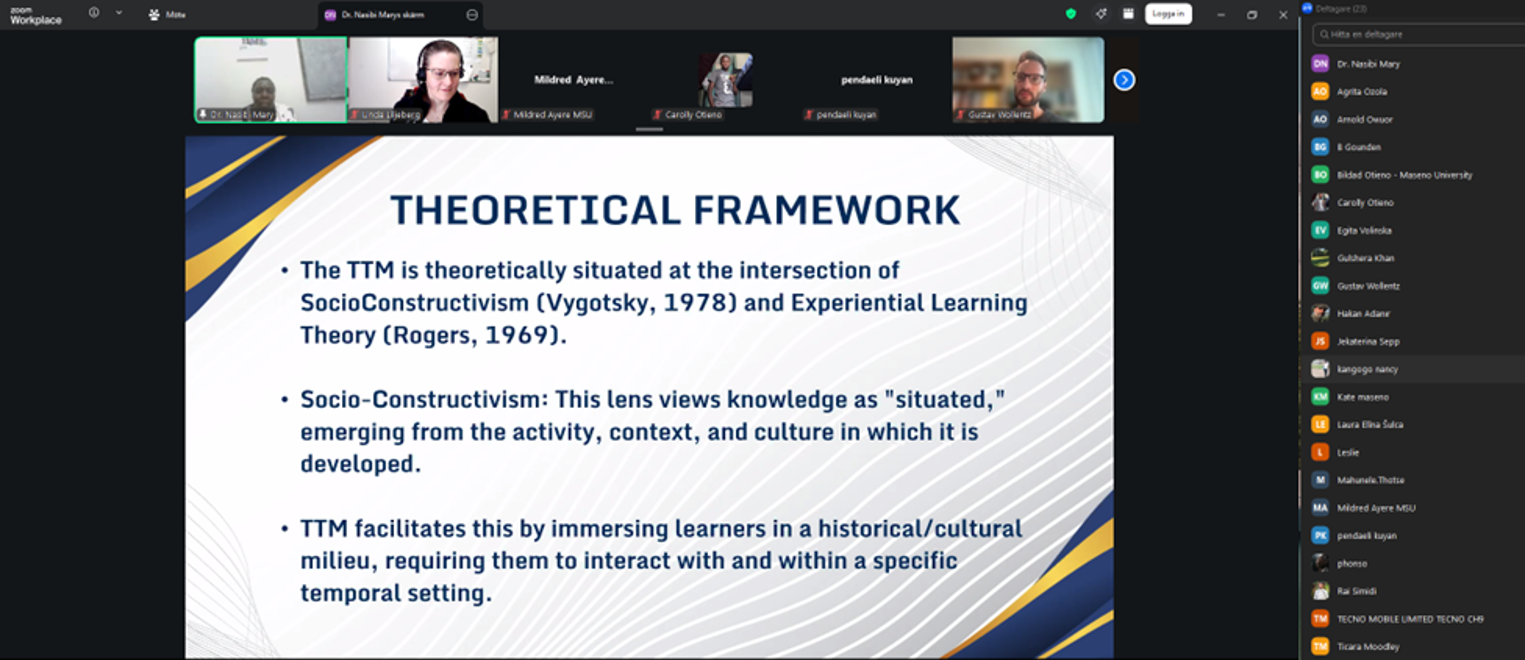
Mary Nasibi of Kenyatta University examined the application of the Time Travel Method within junior schools in Kenya. Her presentation focused on the opportunities experiential learning offers young learners, particularly in making history and heritage more accessible, engaging, and relevant within classroom contexts.
Dr Nasibi highlighted how the method encourages active participation, critical thinking, collaboration, and empathy among learners. By placing children within carefully constructed historical scenarios, learners are able to engage with the past in meaningful ways that move beyond textbook learning. At the same time, she addressed the practical challenges facing implementation in schools, including curriculum pressures, limited resources, teacher preparation, and balancing historical accuracy with age-appropriate learning experiences.
Her presentation reinforced the importance of innovative teaching approaches in strengthening history education across African schools.
Ethical Considerations in Community-Based Heritage Research
Sussy Gumo of Maseno University. Kenya also explored the ethical dimensions of conducting community-based heritage research within Time Travel projects.
Prof Gumo emphasised that heritage work requires sensitivity, mutual respect, and meaningful collaboration with communities whose histories and lived experiences form the basis of Time Travel activities. She discussed the responsibilities researchers carry when interpreting cultural practices, oral histories, memory, and identity, particularly within communities that may have experienced marginalisation or historical trauma.
Her presentation encouraged practitioners to approach research not simply as academic inquiry, but as a shared process grounded in trust, participation, and accountability. Ethical considerations, she noted, remain central to sustaining respectful and inclusive heritage practices.
Epistemological Considerations – Studying Experiential Learning in Heritage Contexts
Dr Rueben Gounden of the Port Shepstone Twinning Association examined how to study experiential learning in heritage contexts, focusing on the Time Travel method. It contends that learning involves meaning-making shaped by experience, reflection, and engagement with history and culture, rather than just acquiring facts. Dr Gounden emphasises that activity and engagement alone do not ensure meaningful learning.
The presentation identified four key indicators of authentic learning:
- The mind – learners think critically, make connections, and construct deeper understanding.
- The heart – learners develop empathy, values, and emotional connection to historical experiences.
- Reflection – learners interpret experiences through dialogue, storytelling, and self-reflection.
- Action – learners demonstrate lasting behavioural change and apply learning in real life.
He emphasises that reflection connects experience and understanding, and that transformation is the goal of experiential learning. It also highlights the value of observation, dialogue, interviews, and reflective practices in assessing learning outcomes. The Time Travel method is presented as a transformative educational approach that shapes both knowledge and character, rather than just a heritage activity. Real learning is demonstrated when learners change intellectually, emotionally, and behaviourally over time.
Safeguarding Intangible Heritage Through Time Travel
Annina Ylikoski highlighted the importance of the Time Travel Method as a practical tool for safeguarding intangible cultural heritage.
Drawing on extensive international experience in heritage education and community work, Annina demonstrated how Time Travel activities can help preserve traditions, customs, oral histories, music, crafts, and everyday cultural practices that are often vulnerable to disappearance. Her presentation illustrated how communities themselves become active participants in transmitting cultural knowledge across generations.
She also reflected on the growing international recognition of intangible heritage and the important role that museums, schools, and cultural organisations can play in ensuring that heritage remains a living and participatory process rather than a static representation of the past.
Digital Tools and the Future of Time Travelling
Gustav Wollentz of Linnaeus University explored the opportunities and challenges presented by digital technologies within Time Travel work.
His presentation examined how digital tools can expand participation, accessibility, interpretation, and creative engagement within heritage education. At the same time, he cautioned against allowing technology to overshadow the human and community-centred aspects that remain central to the Time Travel Method.
Gustav discussed the balance between innovation and authenticity, encouraging practitioners to critically consider how digital resources are used in heritage settings. The presentation highlighted the growing importance of digital literacy and foresight as heritage organisations continue adapting to rapidly changing technological environments.
Strengthening International Collaboration
Collectively, the webinar presentations demonstrated the diversity and adaptability of the Time Travel Method across different educational, cultural, and social contexts. While each speaker approached the subject from a distinct disciplinary perspective, common themes emerged around participation, ethical engagement, experiential learning, community collaboration, and the safeguarding of both tangible and intangible heritage.
The webinar further strengthened international networks among educators, researchers, museums, and heritage organisations committed to advancing the Time Travel Method globally. Importantly, it reaffirmed the value of collaborative learning and dialogue in shaping more inclusive, reflective, and community-driven approaches to heritage education.
As the Time Travel Method continues to develop internationally, such engagements remain vital in sharing knowledge, fostering partnerships, and exploring new possibilities for heritage learning in the future.